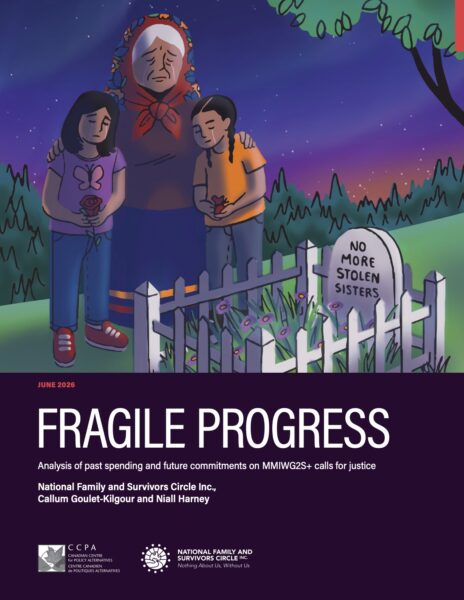
Fragile Progress
On June 3, 2019, the National Inquiry into Missing and Murdered Indigenous Women and Girls (MMIWG) released its final report, Reclaiming Power and Place. It included 231 clear calls for justice for Canada’s Missing and Murdered Indigenous Women and Girls. Seven years later, this report tracks progress—and regress—on federal government actions to respond to those calls.
When it comes to funding the 231 calls for justice, the federal government has spent or committed to spend $146.3 billion from 2019-20 to 2030-31—with $24.7 billion more coming from new programs spanning key areas such as child welfare, housing and infrastructure, health and wellness, culture, and safety. These investments reflect a recognition that the violence faced by Indigenous women, girls, and gender-diverse people is systemic, and that ending it requires sustained coordinated action.
However, the findings of this report make clear that this progress is fragile. Nearly half of all federal programs linked to the calls have ended or are at risk of being sunsetted in the coming years. Annual spending on new programs is expected to fall from a peak of $3.7 billion in 202425 to approximately $1.8 billion from 2028-29 onwards—a 51 per cent funding cut that risks erasing recently developed social infrastructure and reversing progress.
Importantly, this pattern reflects what many Indigenous governance scholars describe as “austerity through expiration”—where commitments are not explicitly withdrawn but are, instead, allowed to lapse, producing structural instability while preserving the appearance of ongoing reconciliation investment.